Friday, February 13, 2009

Just a Few Pictures of Our Recent Snowfall

Well, I haven't posted in months, so I thought I'd get back into the swing by posting a few pictures of our substantial (for Tucson area) snowfall which we woke up to the other morning. Believe me, it was quite a surprise. We knew there'd be a chance, but nothing like we ended up getting. Really beautiful to see and fun to be in -- for a few minutes!


Tuesday, October 07, 2008

Pool Update


These are a few shots of what's going on out back. So far, so good. No problems.

I Finally Found a Use for My Fish Poacher

Let just start out saying this is the second time I've made this recipe, and liked it way better the first time through. I think I know why; there are a couple of differences. The first go-around, I tied together two pork loins, cut from a full loin bought at Costco. Also, I used dried sage, not fresh. Okay, so those are the main differences. The wider thickness of the two loins tied together allowed a longer roast, so it didn't dry out. Also, the fresh sage is so incredibly strong that it gave the second roast a soapy taste. Not pleasant! I tell a lie; there's a third difference. The first time, I used thin slices of pancetta, not smoky bacon. With the bacon, the roast was constantly bathed in bacon fat, so it kind of stewed in a pool of juicy fat, which I ended up draining off.
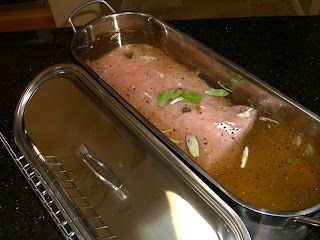


Enough with all that. How do you like my new brining vessel? It worked perfectly, and I'll use it again for pork roasts and cut-up chickens. The fish poacher has sat in its original box, on a shelf in a storage bin in the garage, for the last twelve years. I'm so glad it wasn't donated to the thrift shop. It fits nicely on the fridge shelf too, not too bulky.

Here's the recipe from Epicurious, with my parenthetical changes/comments.


Bacon-Wrapped Maple Pork Loin

For brining pork
8 cups water
1/3 cup kosher salt
2 tablespoons maple syrup (Grade B or amber)
1/2 teaspoon crushed black peppercorns
2 sprigs fresh sage (dried is fine, actually not as strong)
1 large garlic clove, smashed
1 Turkish or 1/2 California bay leaf
1 (4- to 4 1/2-lb) boneless pork loin roast, trimmed (I used two tied together)

For roasting pork
3 garlic cloves, finely chopped
2 tablespoons finely chopped fresh sage (used 1 tablespoon dry)
3 tablespoons maple syrup (Grade B or amber)
16 bacon slices (about 1 lb) (Better with pancetta)
1 tablespoon cider vinegar
1/2 teaspoon cornstarch
1 teaspoon water

Brine Pork:

Combine all brining ingredients except pork loin in a 3- to 4-quart saucepan and heat over high heat, stirring, until salt is dissolved. Pour brine into a deep 4- to 5-quart pot; cool to room temperature, uncovered, about 2 hours.

Add pork to brine, making sure it is completely covered by brine, and marinate, covered and chilled, 8 to 24 hours.

Roast pork:
Put oven rack in middle position and preheat oven to 350°F.

Pat pork dry (discard brine) and remove any strings, then transfer to a roasting pan. Stir together garlic, sage, and 1 tablespoon syrup in a small bowl and rub all over pork. Lay bacon slices crosswise over loin, overlapping slightly, and tuck ends of bacon underneath loin.

Roast pork until thermometer registers 140°F, about 1 1/4 hours. Stir together 1 tablespoon syrup and vinegar until combined. Brush vinegar mixture over bacon slices and continue to roast pork until thermometer registers 150°F, about 10 minutes more. Remove from oven and let stand in pan 15 minutes. Transfer roast to a cutting board with a lip, reserving juices in pan, and let roast stand, uncovered, while making sauce.

Skim fat from pan juices and discard, then transfer jus to a small saucepan and bring to a simmer. Stir together cornstarch and water and whisk into jus. Simmer, stirring, until slightly thickened, about 1 minute. Remove from heat and stir in remaining tablespoon syrup. Serve pork with sauce.

Sunday, September 28, 2008

Follow this Blog!

I've added a "Followers" widget on the sidebar, so if you want to let us know you're reading our blog, please sign up. Thanks!

Apple Galette

Here's a recipe from America's Test Kitchen I saw on PBS the other day. I had a large container of Fuji apples from Costco to use up, so this sounded perfect. I used the suggested weight measurements, as this usually is more accurate. There was a significant difference between the volumes and weights. The fraisage process sounded a bit intimidating, but really there's nothing to it. Next time though, I'd be a bit more observant while adding the ice water. I think I went one tablespoon too much, and this made the dough a bit wet, but it rolled out just fine. The result was nice and flaky with not too much sweetness. The Costco and Sam's Club here do not sell heavy whipping cream (!@#%+!!!!), so we used the old-fashioned canned Redi Whip type and that was fine. This is a lot for two people, but it holds up for a few days just fine at room temperature. I think this could be made using more apples, cut a bit thicker, for more apple flavor, but as written it's fine too.
Apple Galette

Serve with vanilla ice cream, lightly sweetened whipped cream, or creme fraiche.

Serves 8 to 10

Dough
1 1/2 cups unbleached all-purpose flour (7 1/2 ounces)
1/2 cup Wondra flour or Pillsbury Shake and Blend instant flour (2 1/2 ounces)
1/2 teaspoon salt
1/2 teaspoon sugar
12 tablespoons cold unsalted butter , cut into 5/8-inch cubes (1 1/2 sticks)
7-9 tablespoons ice water
Apple Filling
1 1/2 pounds apples (3-4 medium or 4-5 small), see note above
2 tablespoons unsalted butter , cut into 1/4-inch pieces
1/4 cup sugar
2 tablespoons apricot preserves (used peach preserves mixed with blood orange marmalade)
1 tablespoon water


1. CUT IN BUTTER: Combine flours, salt, and sugar in food processor with three 1-second pulses. Scatter butter pieces over flour, pulse to cut butter into flour until butter pieces are size of large pebbles, about 1/2 inch, about six 1-second pulses.

2. ADD WATER: Sprinkle 1 tablespoon water over mixture and pulse once quickly to combine; repeat, adding water 1 tablespoon at a time and pulsing, until dough begins to form small curds that hold together when pinched with fingers (dough should look crumbly and should not form cohesive ball).

3. FORM MOUND: Empty dough onto work surface and gather into rough rectangular mound about 12 inches long and 5 inches wide.

4. FRAISAGE AND CHILL: Starting at farthest end, use heel of hand to smear small amount of dough against counter, pushing firmly down and away from you, to create separate pile of dough (flattened pieces of dough should look shaggy). Continue process until all dough has been worked. Gather dough into rough 12 by 5-inch mound and repeat smearing process. Dough will not have to be smeared as much as first time and should form cohesive ball once entire portion is worked. Form dough into 4-inch square, wrap in plastic, and refrigerate until cold and firm but still malleable, 30 minutes to 1 hour.

5. CUT APPLES: About 15 minutes before baking, adjust oven rack to middle position and heat oven to 400 degrees. Peel, core, and halve apples. Cut apple halves lengthwise into 1/8-inch-thick slices.

6. ROLL AND TRIM DOUGH: Place dough on floured 16 by 12-inch piece of parchment paper and dust with more flour. (I rolled out between two pieces of parchment paper the size of the half sheetpan.) Roll dough until it just overhangs all four sides of parchment and is about 1/8 inch thick, dusting top and bottom of dough and rolling pin with flour as needed to keep dough from sticking. Trim dough so edges are even with parchment paper.

7. FORM BORDER: Roll up 1 inch of each edge and pinch firmly to create 1/2-inch-thick border. Transfer dough and parchment to rimmed baking sheet.

8. LAYER APPLES AND BAKE: Starting in one corner, shingle sliced apples to form even row across bottom of dough, overlapping each slice by about one-half. Continue to layer apples in rows, overlapping each row by half. Dot apples with butter and sprinkle evenly with sugar. Bake until bottom of tart is deep golden brown and apples have caramelized, 45 to 60 minutes.

9. GLAZE: While galette is cooking, combine apricot preserves and water in medium microwave-safe bowl. Microwave on medium power until mixture begins to bubble, about 1 minute. Pass through fine-mesh strainer to remove any large apricot pieces. Brush baked galette with glaze and cool on wire rack for 15 minutes. Transfer to cutting board. Cut in half lengthwise and then crosswise into individual portions; serve.

Thursday, September 18, 2008

Fabulous Lemon Bars


While I'm sitting here and posting, I might as well add this recipe for lemon bars I copied the other from Happy in the Kitchen. I'll keep this really short and sweet.

Recipe: Very easy.
Result: Yummy!
Repeatability: Yes.

Enough said. Here's the recipe. Only change I made is addition of about 1/4 cup finely processed almonds to the shortbread dough.

LEMON BARS
This is a good party recipe as it makes 2 dozen squares or about 48 small triangles
2 cups for the pastry+ 1/4 cup flour- for filling
1/2 cup powdered sugar
1 cup unsalted butter- room temp
2 cups sugar
4 large eggs
zest of one lemon
1/2 cup fresh lemon juice
For the crust:
Preheat the oven to 350 degrees.
Beat the butter and powdered sugar in an electric mixer until creamy. Add the 2 cups of flour and beat on low till well combined.
Press the mixture evenly into a 9x13 inch baking pan (pyrex works best; silly me, I used metal, should have used glass as suggested) working the dough up about 1/2 inch the sides.
Bake for about 20 minutes.
For the filling:
In a large mixing bowl, whisk together the sugar, the 1/4 cup flour, the eggs, lemon juice and zest.
Pour over the crust and bake for another 20 minutes until set in the center.
Allow to cool completely. Then put in the fridge - it will be easier to cut when cold.
Dust with powdered sugar before serving.

Big Shoutout to Lisa et al. at Mountain View Ranch H.O.A.


Thanks for your help yesterday, Lisa and Tony. Enjoyed chatting and getting to know you a bit -- finally!

Easy Challah


I saw this version of challah on The Desert Sun site the other day, and since it's almost time for Jewish New Year, I set out to make a batch. I've made challah before, and it always comes out great, no matter which recipe or the source. One thing I've found is true, though: I always -- ALWAYS -- end up adding a lot more flour than called for. If only 4 cups of flour were added, as written in the recipe, I'd end up with a wet, sloppy, unmanageable blob of dough which never would rise or hold a shape. I didn't keep track, but at least another 1 1/4 cups of flour were needed to make the dough right. The only other change I made was the addition of about 1/4 teaspoon of good vanilla extract. I'd considered using half a vanilla bean's worth of seeds but didn't; possibly too much vanilla would come through. For the initial and second risings, and to provide extra humidity, I boiled some water in the microwave and placed it in the oven with the bowl of dough. When shaped into braids, I placed each on on separate parchment-covered sheet pans. I find with two on one pan, they usually end up touching and merging when baked. These loaves came out perfect: dark golden color, shiny on top from the prebake eggwash, and more like a cake texture than bread. Eddie and I could not resist and had some slices with soft unsalted butter to go alongside leftover and reheated chili-lime chicken wings. (Yummy!!) Tonight, we'll have soft-scrambled eggs and French toast. Cant' wait!

Easy Challah

Start to finish: 4 hours (30 minutes active). Makes 2 loaves

1 teaspoon sugar

1 cup warm water, about 110 F

2 teaspoons active dry yeast (-ounce package)

1/4 cup honey

3 large whole eggs, divided

3 large egg yolks

(1/2 teaspoon vanilla extract, optional)

1/4 cup vegetable oil, plus more for bowl

1 tablespoon salt

4 cups all-purpose flour, plus more for kneading

1 tablespoon whole milk

In the bowl of a stand mixer, combine the sugar, water and yeast. Mix until the yeast is dissolved. Let sit until foam develops on the surface of the water, about 5 minutes.

In a medium bowl, whisk together the honey, 2 of the whole eggs, all 3 egg yolks, and the oil. Add to the yeast mixture.

Add the salt and flour, then use the mixer's dough hook attachment to mix on low until combined, about 1 minute. Increase speed to medium and continue mixing until the dough is smooth and elastic, about 6 minutes.

Lightly coat a large bowl with oil, then transfer the dough into it, turning the dough once to completely coat with oil. Cover the bowl with a clean kitchen towel and set in a warm place until the dough doubles in volume, about 1 hour.

Transfer the dough to a dry work surface and punch down lightly to remove air that has gathered inside the dough.

Reshape the dough into a ball and return to the oiled bowl, again turning the dough to coat with oil. Cover the bowl with the towel and set in a warm place until the dough doubles in volume, about 1 hour.

Lightly coat a large baking sheet with cooking spray or line it with parchment paper.

Divide the dough in 2. The dough can be shaped into a standard loaf and baked as is. It also can be braided into a more traditional challah design. The number of braids determines the complexity. Three is a good number for beginners.

To do this, divide each piece of dough into three equal parts. Using your hands, roll each portion of dough into strands about 12 inches long and about 1 inch wide. You should have a total of 6 strands.

Gather together 3 strands and pinch them together at one end. Arrange the strands on the counter such that the pinched end is away from you and the strands fan out toward you.

Take the rightmost strand and bring it over the center one, dropping it between the center and left strands. Take the leftmost strand and bring it over the center, dropping it between the center and right strands. Continue this action of crossing the strands over one another until the strands have been fully braided. Be sure to pause occasionally to adjust the already braided portions so that they lay evenly and in a consistent pattern.

At the end of the braid, pinch the ends of the strands together and tuck them under the loaf. To make the second loaf, repeat this process with the remaining 3 strands of dough. Carefully transfer the braided loaves to the prepared baking sheet.

In a small bowl, whisk together the remaining egg and the milk. Use a pastry brush to coat the surface of each loaf with the egg mixture. Reserve excess egg mixture in the refrigerator.

Cover the loaves loosely with plastic wrap, then place them in a warm spot to rise until the loaves have doubled in volume, about 1 hour.

Heat the oven to 350 F.

Lightly brush the loaves with the remaining egg mixture. Bake until the loaves have risen and are a deep golden brown, 45 to 50 minutes. Transfer the loaves to a wire rack to cool completely.

Monday, September 08, 2008

Are You Old Enough to Remember Her?

Are you old enought to remember the comedian Totie Fields? If not, she was a top performer from the 60's and 70's, best remembered for her acts on The Ed Sullivan Show and live shows in Las Vegas. She made irreverent fun of her weight problems and just about everything else. When in Vegas, she could get away with a lot more risque humor that Sullivan would not tolerate. I came across videos of her show at the Sahara after her return from a leg amputation due to complications from a blood clot. Tragically, she died two years later. I had forgotten how funny she was. Here's a clip that really made me bust out laughing late last night.